


Riviera Maya, Q.R. — The sargassum situation predicted for the Caribbean region next year is being addressed now by state officials. Quintana Roo authorities met Monday to discuss strategies to deal with the anticipated heavy flow of seaweed for 2027.
According to Cancun Mayor Ana Paty Peralta, so far this year, Cancun has removed over 32,000 tons of the seaweed from its beaches, an increase of nearly double that of last year.
Scientists predict that next year for 2027, the sargassum season will yield even more seaweed with 80 million tons. That figure is up from 2025 when scientists reported 38 million tons and in 2026 when the tonnage increased to 60 million.
On Monday, the administration of Quintana Roo Governor Mara Lezama met to discuss the ongoing strategy to deal with the ever-increasing bloomage of seaweed.

To strengthen actions to address sargassum and advance solutions based on science, technology and international cooperation, Governor Lezama led a working meeting to strengthen the comprehensive strategy that allows confronting the arrival of this macroalga on the coasts of Quintana Roo.
During the meeting, she emphasized that her administration maintains ongoing coordination with the Mexican government, scientific institutions, and international organizations to address this phenomenon that affects not only the Mexican Caribbean, but also various countries in the region including the United States.
“We continue working on the macroalga, sargassum, which affects the entire Caribbean, and it must be made very clear, not only the Mexican Caribbean, but the entire Caribbean.
“Not a day goes by that we are not working on a strategy,” said Mara Lezama.

The Governor thanked President Claudia Sheinbaum Pardo for her support, who has included addressing sargassum among the priorities of the Federal Government. In recent days, Sheinbaum visited the Sargassum Monitoring Center in Cancun to learn about the technological tools used in monitoring the macroalga.

October 16, 2026.
One of the central topics of the Monday meeting was the operation of this specialized center, which through an agreement with the European Space Agency has access to information from 12 satellites, mainly from the Sentinel family, to identify the presence, dimensions, trajectory and speed of movement of the sargassum.

Through a specialized algorithm, the center allows the analysis of ocean currents, winds and other factors that influence the movement and abundance of the macroalga, with satellite images of up to 10 meters of spatial resolution.

Governor Lezama explained that these tools allow tracking sargassum from waters near the African continent to its approach to the Mexican Caribbean, providing fundamental information for decision-making and strengthening the region’s strategy.
Also, during the meeting, the scientific research work being carried out in coordination with the Scientific Research Center of Yucatán (CICY) was discussed, including tests to evaluate the possible use of sargassum in the preparation of food for certain species.
The Governor emphasized that science, engineering, and technological innovation represent fundamental tools for finding alternatives for the use and valorization of this macroalga, through the joint work of specialized institutions.

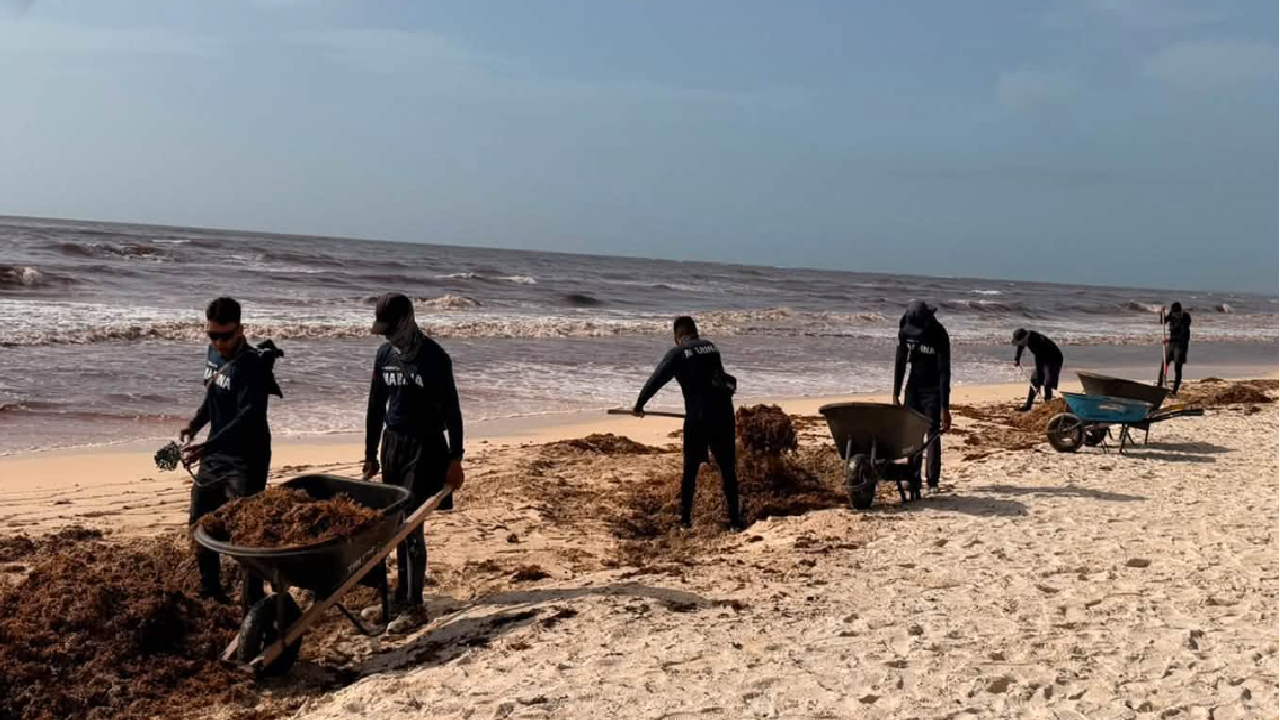
In this regard, she acknowledged the participation of the Secretariat of the Navy, environmental agencies, specialists and cooperation organizations that contribute to the development of actions for monitoring, research, collection and disposal of sargassum.
She also recalled that Cancun recently hosted over 350 representatives from more than 45 countries at the 4th EU-Caribbean Global Gateway Conference on Sargassum that allowed for the exchange of experiences, the learning of new technologies, and the strengthening of cooperation to address this problem shared by various nations.
She emphasized that through the Global Gateway initiative and cooperation mechanisms with European countries, spaces for dialogue remain open to promote scientific and technological solutions that allow for improved management and use of sargassum.
Lezama reiterated that her government will continue to strengthen inter-institutional coordination, scientific research, and international cooperation to advance comprehensive sargassum management, protect coastal ecosystems.

Across the state, over 133,000 tons of sargassum has been collected from beaches during the 2026 season.
According to figures presented during the 4th EU-Caribbean Global Gateway Conference on Sargassum last week, in 2025 there were around 38 million tons of sargassum floating in the Atlantic.

Scientist say that in 2026, the figure increased to 60 million and that next year, approximately 80 million tons are estimated for 2027.
According to Ocean Services of the NOAA and the UN Environment Programme, the driving factors increasing sargassum bloomage include nutrient enrichment from sources such as agricultural runoff from fertilizers from land-based agriculture and climate change. Rising sea temperatures are also helping to speed up the growth rate of sargassum.

